Tiling
Backsplash, shower, and floor tile with clean, straight grout lines.
Learn More about Tiling →Flooring · Scarborough, ON
Laminate and vinyl plank flooring installed as part of basement finishing and full renovation projects, with proper subfloor prep for a level, lasting result.
Flooring pairs naturally with our drywall and tiling work for a fully finished room in one visit, most often as part of a basement finishing project, where a level, moisture-appropriate subfloor and a clean laminate or vinyl plank installation complete the space alongside the drywall and paint.
Subfloor prep matters more than the flooring material itself. An uneven or damp subfloor will telegraph through even a premium plank, so we check and correct the base before any flooring goes down.
Every flooring quote is free and included as part of the overall project estimate when it's paired with basement finishing or a larger renovation.
Below grade the answer is usually vinyl plank rather than laminate, which is why it comes up on nearly every Pickering and Ajax basement we finish.
Laminate vs Vinyl
These two get compared constantly and they are not interchangeable. The deciding factor is almost always moisture, which is why the answer is usually different upstairs than it is in a basement.
We install laminate and vinyl plank most often as part of a basement finishing or full renovation, where the subfloor is already open to inspect and correct before anything goes down.
Recent Work
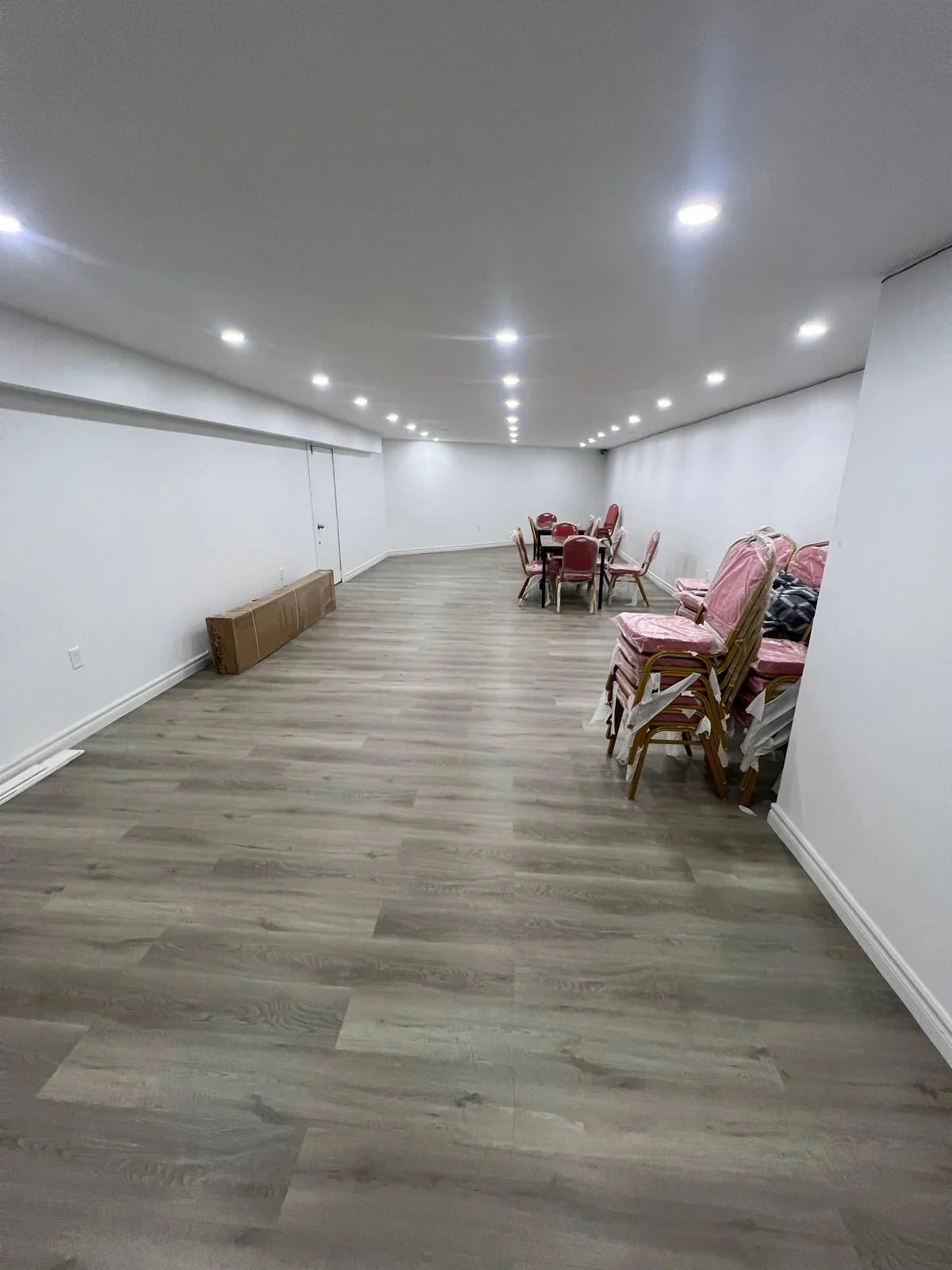
Basement Flooring
Keep Exploring
Backsplash, shower, and floor tile with clean, straight grout lines.
Learn More about Tiling →Unfinished basements turned into livable square footage.
Learn More about Basement Finishing →Board hung plumb and square, prepped for a flawless tape finish.
Learn More about Drywall Installation →Common Questions
Vinyl plank, in almost every case. It is synthetic the whole way through so it tolerates the humidity and occasional moisture of below-grade space, while laminate has a wood-based core that swells if it gets wet.
Yes, and it is the step most often skipped. Both laminate and vinyl plank float over the subfloor, so any dip or hump underneath turns into flex, gapping or a hollow sound later. Correcting it first costs far less than lifting a finished floor.
Yes, which is the normal situation in a basement. The slab needs checking for flatness and moisture, and the right underlay or vapour barrier goes down first, matched to what the slab is doing.
Usually. Both products need an expansion gap at every wall, and hiding that gap behind baseboard or quarter round is the cleanest result. Floors installed tight to the wall are the ones that peak and buckle later.
Most of our flooring goes in as part of a basement finishing or full renovation, where the subfloor is already open to inspect and correct. We do take flooring on its own, and it is worth asking when you call so we can look at the subfloor properly.